• Home
  • What is ASEN?
  • How do I get involved?

Welcome

The Australian Student Environment Network (ASEN) is the network of environment collectives at universities, TAFEs and high schools across Australia. Every year ASEN organises the Students of Sustainability Conference (SoS), Australia’s largest and longest running environment conference. Other key initiatives of ASEN include the annual Summer Training Camp, the campus renewable energy campaign, nuclear-free campaign, and organic food co-operatives. Every day ASEN is engaging and empowering the next generation of environmental and social justice campaigners.

Donate to ASEN

Read More
Jul 30

Looking after Ourselves: A workshop outline

Looking after your wellbeing, asking for your friends support, and being a helpful support person

- This article talks about  some of the manifestations of anxiety, depression and burnout and could be triggering. It might be a good idea to read it with support and friends and comfy pillows around-

So our WASEN (and extended) crew included a bunch of maggotheads that had been working and sometimes living pretty closely with each other. Perhaps we had pushed ourselves and our relationships too far; certainly burnout was an issue for most of us and at times communication was frustrated and underused. We needed a weekend away together in the bush to hang out, cook, play, breathe and do some workshops that would help us understand where we are at and how we can support each other. The Totally Rad Skillshare was conceived and this workshop based on self-reflection and sharing was created.

- This article has been structured so you can go through it on your own and ask your self the questions, and maybe let a friend know some of the answers. It has also been written so that others can take it, mess it around and use it with their mob. We thought we would leave our names in to show how we broke down the co-facilitation and kinda make it more personal. We aimed for about 65 minutes. -

DOM      GOAL: Introduce people to the intention of the workshop.

I’m sure you’ve all heard heaps of really great advice about how to lead a more balanced life, how to work at a level that’s more sustainable and prevent burn out; but there’s a big difference between knowing what to do (or the general idea of what to do) and actually doing it. And the only person who can live your life is you. We all have really diverse experiences and different issues that affect the sustainability of our work and activism and our lives. Some things will work for some people and not for others. Yet while we are all unique, there are many common threads in all our experiences so that we are able to relate to each other. No one can tell us how to be more sustainable in our activism, but we can all share knowledge and  understanding; from other people, from literature, and from personal experiences. The aim of today is to do this in a safe, supportive, open, creative space such that this process may be empowering for us to realise how we can recognise what’s going on inside ourselves, improve our wellbeing and avoid burnout. Ahem a lot of this workshop is based on others before it, from somewhere, probs asen or the change agency but we can’t find the original so can’t thank them DODGY! ASEN and The Change Agency have websites that are easy to use and have heaps of hott resources and workshop structures fyi http://www.thechangeagency.org/ and http://asen.pbworks.com/ISMzine

If facilitating: Go through the agenda.
~5 minutes~

NAE              GOAL: Reflect on what makes a supportive and frustrating listener for                you and others.

“Think about a time when you have talked to someone and found it a negative experience, what were the problems? Think about another time that felt positive, what felt good about it.”

If facilitating: Snowball, which means to write both experiences down on separate pieces of paper, screw them up and chuck them in the middle of the circle. Each person picks up a couple from the middle and reads them out in turn, giving space for discussion.

~15 minutes~

DOM       GOAL: identify for yourself how you look when you are unbalanced / burning out; let someone/s know the things you want them to know.

This bit can be done whilst lying on your back, to encourage introspection and concentration. “What do you do when you are going through a tough time? These first things I mention could be thought of as problem distancing, and can be helpful for getting perspective etc; do you withdraw and push people away, go on a holiday, cut yourself, eat lots of food, bite your nails, take drugs. These examples can be thought of as problem solving; explaining your boundaries or feelings to someone, meditation/relaxation, exercise, reducing your work load, strategic planning (where you want to go, what you want to achieve and how you are going to do it).”

If you are doing this by yourself it’s a good idea to write these things down so that you can refer back to it at a later date.

If facilitating: very slowly go through the list of things folks might do. Then, ask people to find a partner they feel comfortable with and share what they want to. You can also come back to a group circle and ask people to share one or two things with the big group they are comfortable sharing, we think this can help people feel they are not alone in having things they do when they feel stressed.

~15 minutes~

NAE          GOAL: identify what you need when you are burning out or burnt out.

“Think about the things you need for a balanced life, which might include: good food, enough sleep, connection with others, laughter, play, meaningful work. How can you, with the support of friends, ensure you have these things in your life?”

If facilitating: this is a paired listening exercise with a report back to the big group.

~10 minutes~

Might be an idea to write this down on a bit of paper if doing this alone by making two columns. One column listing the things I do when burning out and things that I need to regain my balance, decorate it and put it somewhere you will see it regularly.

NAE    GOAL: share knowledge of alternative cure options to draw on when feeling unbalanced.

“What is a herb or some other weird thing you know that helps with stress/ balance, what is it good for, and how do you prepare it?”
~10 minutes~

DOM     GOAL: De-pack; reflect on what you have learnt and give feedback to organisers on how it could be improved.

If facilitating: round robin, “what was one thing you enjoyed, one thing that bugged you, and one thing you may incorporate into your life?”

~10 minutes~

If you run something based on this or have questions/suggestions, please contact us at Dominique.lieb@gmail.com

From some learners who want to share

Renae n Dom

Read More
Jul 28

Iron and Sand in Kulon Progo

by Perth-Kulon Progo Solidaritas Collective

Perth based companies Indo Mines ltd. and Kimberly Diamonds are complicit in the attempted violent eviction of an Indonesian farming community from their traditional lands. In Kulon Progo, Yogyakarta, Indonesia, an autonomous farming community of thousands of people is facing a terrible fate – the need to fight for their lives. After perfecting techniques for farming the sand on which they live, they have rudely been informed that their fertile top soil covers a large iron deposit, which the Sultan of Yogyakarta, the Indonesian government and Perth based companies Indo Mines and Kimberly Diamonds are too eager to exploit for profit, with or without the farmers’ consent.
Their struggle for freedom has been going since the community was first informed about the plans to mine their land in 2006. Since then they have a formed an independent, community and consensus run organisation, the PPLP (the Association of Shoreline Farmers) that has helped mobilise resistance with an impressive size and intensity. Farmers have demonstrated in their thousands, occupied government buildings in Kulon Progo and Yogyakarta city, endured a violent attack by a fascist militia and police,  and secured the release of a friend from police custody.
Two of us recently visited the village to witness the farmers’ struggle against eviction first hand. In between planting chilli seeds, drinking fresh coconut juice in the fields and eating recently harvested melons, we  interviewed farmers about their lives and views on the campaign to protect their land . When informed that Indo Mines, on their website, claim that:
“the area within the project boundaries is considered extremely marginal for farming with only minor areas that support traditional farming. The Company believes the Project will have a positive impact on these activities”
one farmer responded that those people have never visited the farms to witness their fertility or consulted with farmers and should do so. In fact, Kulon Progo is relatively wealthy compared to other farming villages in Java because of the diverse variety and quantity of food grown on the proposed mine site. One farmer we spoke to boasted that “One hundred thousand people eat the food we grow here”. Kulon Progo is also significant for the amount of young people living and farming there. Unlike other parts of Java and Australia, where most young people leave small communities to work in the cities, farming is seen as a viable and attractive life choice for the young generation. No-one in Kulon Progo is exactly sure exactly when mining is planned to start, or how far progressed the plans are, because state and corporate authorities have not been forthcoming with information about their intentions. However, there is one thing that is   sure : many of the men and women in Kulon Progo Are willing to die defending their land. To them, farming is life. To work in a factory or a mine, to become wage-slaves, to leave their land and become refugees is to sacrifice their autonomy, their way of life and their freedom.

The farmers  we spoke to wanted Perth and Australian investors in the project to know what is happening, to know that they are supporting the forceful and violent removal of people from their traditional lands.

While trying to find out information about the mining process and land ownership dispute, Mr. Tukijo, one of the co-ordinators of PPLP, was charged with an offence similar to defamation. At the recent court case, one thousand farmers turned out in a show of strength and solidarity for their friend. They were ready to rescue him from the court if the judge sent him to jail.  Before the demonstration, we were detained by police, as the only two white people there, only to be released after the demonstration was over. Police said this was because they feared ‘the media would realise that this campaign has become international’. The significance of international solidarity was also expressed by the Kulon Progo farmers in a call for Australian activists to take the campaign to the Australian investors and companies.

The Perth Kulon Progo Solidarity collective does not suggest that we should take solidarity action because of a charitable desire to ‘do good’ in the world. Rather we understand that the flow of capital from exploited regions into the centres of wealth like Perth does damage here too. The social cost of extreme wealth in Perth manifests in the crises of our education and health systems, the cost of housing and associated homelessness, and the ever increasing divide between rich and poor. Our struggle and that of the Kulon Progo farmers is one and the same, against capital, state and police.

We learnt that the Kulon Progo farmers are not afraid to militantly defend their freedom from outside aggressors. But more than that, we learnt that they are a peaceful community of people who just want to be left alone to grow their crops and live without interference from the state or capital.The strength of their campaign comes from their intelligent political awareness, their use of consensus decision-making processes, their mistrust of state and capital, their rejection of representation, mediation and NGOs, their emphasis on solidarity, mutual aid, direct action and above all, their absolute commitment to land and freedom.

and quantity of food grown on the proposed mine site. One farmer we spoke to boasted that “One hundred thousand people eat the food we grow here”. Kulon Progo is also significant for the amount of young people living and farming there. Unlike other parts of Java and Australia, where most
Read More
Jul 25

Coal Campaigning in the Land of Plenty

Mining coal has long been perceived as the ‘engine room’ of Queensland’s economy and exploitation of our great mineral wealth is supported by Governments of all persuasions. However if coal is one great resource of our state, then our wonderful natural environment is the other, from the Great Barrier Reef to the tropical rainforests and desert uplands. Now, in this decade, we find ourselves at a decision point. It is becoming increasingly clear that we cannot allow coal mining to continue unabated and expect to our natural treasures to survive.

For politicians, the possibility of transitioning the state to be less dependent on coal is far from consideration, or at best considered fanciful. Indeed, despite international commitments to limit greenhouse gas emissions, the Queensland coal industry is currently undergoing unprecedented expansion, with 21 new coal projects in advanced stages of development.

Escalating Impacts

As coal mining quietly grows to cover larger and larger areas of the state, what value is given to the rural communities that are being broken apart, such as Acland and Wandoan? What value is given to the productive agricultural lands that are threatened, in places like Felton, Warra and Kingaroy? And what value is given to the areas of conservation significance such as Bimblebox Nature refuge and the Carey Valley Wetlands and that are threatened with becoming holes in the ground, or rail corridors? These areas are all subject to planned coal mining and have no legislation to protection them from uncertain futures.

The resistance of farmers against coal mining has become a high profile issue in southern Queensland and the Liverpool plains of New South Wales, where farmers have been successfully blockading coal companies out of one property since July 2008. As coal mining impacts more areas of biodiversity, land owners and conservationists are also resisting and building support for their cause. Conservationists and farmers may appear to be unlikely allies, however they share a strong resolve to resist the destruction of their land by mining. In this they also share similarities with two centuries of struggles by indigenous peoples.

At the last state election, climate activists, conservationists and some farming groups joined forces to push the government for to begin to restrict coal mining on agricultural land and nature refuges. Reflecting this, the restriction of coal mining, at least the agricultural lands, is policy of both the Greens and the Liberal National party.

In urban centres coal has become a focus for many climate oriented organisations and community groups for its dominant role in Australia’s greenhouse gas emissions as well as its direct impacts on the environment, health and food security. For the last three years the Newcastle community has turned out in kayaks and canoes for annual peaceful coal port blockades, and last October marked the first similar blockade in Brisbane. Many people even risked arrest to show their concern, and demonstrations of civil disobedience at coal ports, railways, mines and power stations exploded in 2008, with over are 160 people arrested at demonstrations that year.

While these pockets of resistance give hope that much more can be saved from coal mining, many areas of biodiversity and conservation significance face an uncertain future, and the vast majority of coal projects continue to be approved. Community groups seeking to create change face the deeply ingrained interests of a well-funded and politically powerful coal lobby.

Building alliances between the diverse groups impacted by coal, and sharing their stories to engage many more concerned people, community-lead action may be powerful enough to turn the tide and begin a measured transition to a sustainable future. Transitioning our state away from coal dependence will be a long process, but it is imperative that we at least start looking in the right direction, by right now saying “no new coal”.

About Six Degrees:

Six Degrees is a coal and climate campaign of Friends of the Earth Brisbane. We work with communities and groups across the state to reduce Queensland’s dependence on the coal industry and to ensure a just and measured transition to a safe climate future. www.sixdegrees.org.au

Read More
Jul 25

Climate Justice and the fight against Nuclear

In the last few months I’ve switched from saying I’m doing organising around ‘climate justice’ to ‘anti-nuclear’. This has earnt me a steady critique of the choice to focus on anti-nuclear, with furrows appearing on the questioner’s brow. I know I have to act quickly to have any chance of mounting an argument before my listeners start talking about James Hansen or Tim Flannery.

It’s scary how nuclear seems to be riding on the back of climate change to have returned to the agenda in a big way. And not just the political agenda, but the media’s, the public’s, the universities’ and even those who would self-refer as ‘environmentalists’. I think opposing the nuclear fuel cycle in Australia- the mining, exporting, waste, and possible production of nuclear power, must be included in our ideas of what climate justice means in this country.

I want to explore here some of the powerful experiences I’ve had in these few months focusing on anti-nuclear organising, which have not only reaffirmed for me the horrors of nuclear but also given a glimpse of what real climate justice solutions might look like.

Starting with uncle Kevin Buzzacott, an Arabunna elder, who when I met him a couple of weeks ago on his country near Olympic Dam uranium mine held out speckles of red dirt on his finger- ‘This is you. Not even, wait.’ He brushed all but one tiny speck off. ‘This, this, is you.’

Meeting Uncle Kevin affected me in a number of ways. He has been fighting uranium mining on his country since the Olympic Dam mine was first proposed over 30 years ago. He has also tackled the colonial legal system and the assertion of white sovereignty over his peoples’ land. He told me how he’d been offered countless bribes to quieten down, or end a protest camp, but he knew his number one duty was to care for the earth. He saw his struggle to protect his country from uranium mining as bound up in the fight against white colonialism. This meant fighting against the companies who sought to wrest control over the land from his people.

The grain of sand returns here. Uncle Kevin sees our presence as a mere speck in the thousands of years of life before and after us. He argues that in the 100 or so years since white people had made it onto his country (having taken a while to reach the SA desert as he said “they thought there were too many flies, nothing there”), they have acted like masters of the earth. Like they own all the millions of specks of sand. And in this way they have dug up uranium. Uranium, which can be used for weapons of devastation, which creates a waste product that lasts many millennia, which many are now holding forth as the solution to the most glaring symptom of the ecological havoc we are wreaking- climate change.

Is this really the best we can do? Climate change is upon us because rich nations, companies, people, are exploiting the earth’s resources way beyond our means. We are horrified by the legacy this is leaving, the present and looming affects of climate change, and yet we are turning to answers from the same book. We still think we are the masters of the earth. We are still exploiting the traditional owners of this country. Mining places they say we shouldn’t touch. Planning to bury waste there too.

To me, this isn’t what climate justice looks like. This is no solution I want to be a part of. I think climate justice is about recognising who caused climate change, what systems of power and belief are sustaining our continuing path towards ecological crises – not just climate change but many others too, and listening to those who are already most impacted by these crises.

Which brings me to someone else we met (am not sure if she’d like to be named), an Adnyamathanha elder, near her country around the Flinders and Gammon ranges. She talked about how she and her family still go out camping on their land but are fearful that the water may be contaminated, as it’s near the Beverley uranium mine. She fiercely wants to defend that land from further proposed mines, but can’t get the ear of government, even the Minister for Aboriginal affairs refuses to meet with her and other elders.

Her approach to the land was starkly at odds with the government’s and mining companies’ but seemed so much the wiser. She wanted to be able to live on that land, drink the water, pass it onto her kids, and hated the idea that uranium from her country might be used for weapons or be involved in nuclear accidents in another part of the world. Listening to her, I could feel the beginnings of real alternatives taking seed in my head, pushing out the deadened complacency of business as usual, creating ruptures in the white, capitalist brain we are conditioned to have.

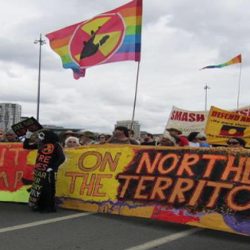
This is also just a beginning. It’s just a scraping of the reasons why we need to stay away from the entire nuclear fuel cycle. There are other articles, other arguments to be found, other people to be listened to. There’s no way I have my head around the intricacies of them all but have heard enough to know that when there is a proposed radioactive waste dump at Muckaty in the NT, a planned expansion of the Olympic Dam and Beverley uranium mines, companies drilling for uranium all over WA, contracts to export uranium to nuclear weapons states, to bring the waste back, and nuclear power proponents in the spotlight all over the country, then it’s high time to do something!

– Emma kefford

Member of ASEN Anti-nuclear and Indigenous Solidarity Working Group and Friends of the Earth Anti-nuclear and Clean Energy (ACE) Collective

Read More
Previous Page 2 of 32 Next Page
    • Events
    • News
    • State Networks
    • Campaigns
    • Resources for Collectives & Activists
    • Membership
    • Publications
    • Contact Us
    • Photos
    • Links
  • Photos
  • Search


always was, always will be, Aboriginal land


Theme based on Color Paper, designed by FTL WordPress Themes.

Back to Top Log in